DEAR STAKEHOLDER,
It is with great pride and a strong
sense of responsibility that I present
the seventh Sustainability Report
of South Asia Gateway Terminals
(Private) Limited (SAGT) to you,
as we reflect on the financial year
2025/26 and advance through our
27th year of operations at the Port
of Colombo. This report provides
a transparent and comprehensive
account of our past performance,
priorities and progress across key
environmental, social and governance
dimensions, all whilst demonstrating
how sustainability considerations are
integrated into our long-term strategy
and daily operational decision-making.
This includes our commitment to
decarbonising operations, having
a diverse workforce and upholding
principles of corporate governance.
Over the past two and a half decades,
SAGT has remained a cornerstone
of Sri Lanka’s maritime and trade
infrastructure. Since commencing
operations in 1999, the Company
has played a pivotal role in shaping
the Port of Colombo into a globally
recognised transshipment hub widely
known for operational efficiency,
reliability and connectivity. Today, as
the external environment continues to
evolve with increasing complexity, the
principles of sustainability, resilience
and responsible leadership have never
been more central to our role as a
terminal operator. This Sustainability
Report is intended as a meaningful
channel of engagement with our
stakeholders including customers,
employees, contractors, regulators,
shareholders, lenders, communities
and partners.
Through this report, we seek to
communicate our approach to
managing risk, capturing opportunity
and creating long-term value in a
manner that balances economic
performance with social responsibility
and environmental stewardship.
THE STRATEGIC ROLE OF THE
PORT OF COLOMBO AND SAGT
The Port of Colombo (PoC) continues
to serve as Sri Lanka’s primary
maritime gateway and a critical
transshipment hub for South Asia and
the wider Indian Ocean region. Its
strategic location astride the EastWest Main Sea Route offers shipping
lines minimal deviation between Asia,
the Middle East and Europe, which
assists in reinforcing Colombo’s
competitiveness in the region. This
strategic positioning has enabled the
Port of Colombo to deliver consistent,
high-volume performance despite
ongoing periods of global economic
uncertainty and regional disruption.
The Port of Colombo is Sri Lanka’s
economic lifeline driving the country’s
trade and foreign exchange earnings.
For local importers and exporters, the
Port of Colombo's connectivity delivers
exceptional value, providing efficient
routes to international markets via
direct services, reducing costs and,
CO2 emissions.
During 2025, the Port of Colombo
achieved a historic milestone by
handling 8.3 million TEUs, the highest
annual throughput recorded since
its inception. Transshipment cargo
accounted for approximately 84%
of total volumes, which reflected
Colombo’s structural orientation
towards international relay cargo
rather than domestic demand.
This transshipment-led profile
has continued to insulate the Port
from residual domestic economic
challenges, while simultaneously
increasing its exposure to global trade
patterns, geopolitical developments
and shipping line network strategies.
Within this operating environment,
SAGT has remained a key contributor
to the Port’s performance handling
1.8 million TEUs in the financial
year 2025/26 which continued
to operate well above its original
design capacity of 1.1 million TEUs,
underlining the terminal’s operational
efficiency, planning discipline, and
workforce capability. Since the time
of inception, SAGT has set industry
benchmarks in productivity, customer
service and operational reliability,
playing a primary role in positioning
Colombo as the preferred gateway
to the Indian subcontinent. Our
longstanding focus on efficiency, asset
optimisation, workforce capability
and continuous improvement has
enabled the Company to consistently
outperform its original design capacity
and respond effectively to changing
customer requirements.
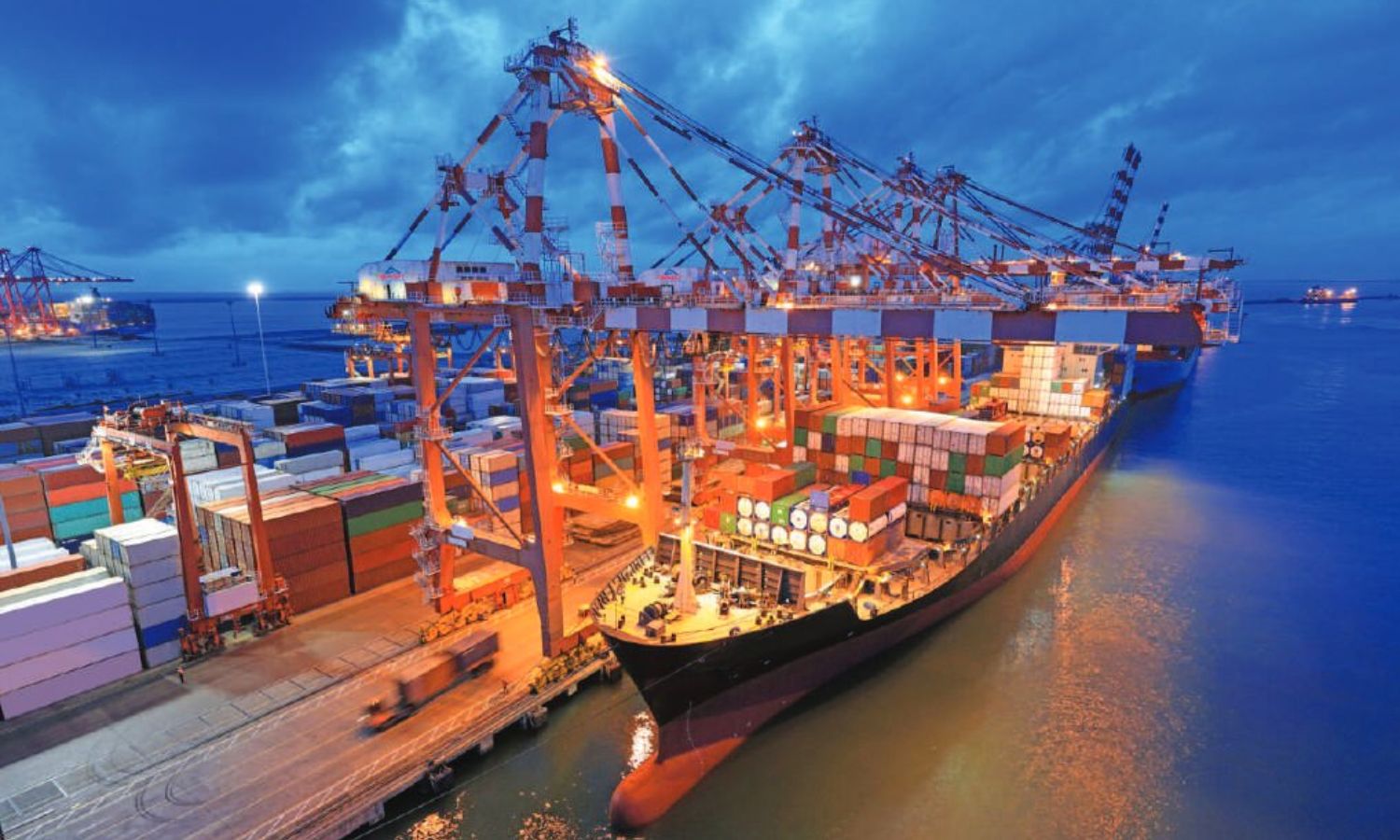
Over the past two and a half decades, SAGT has remained a cornerstone of Sri Lanka’s maritime and
trade infrastructure
GLOBAL TRADE DYNAMICS AND
EVOLVING OPPORTUNITIES
The global maritime industry
continued to operate under
heightened volatility during the
reporting period. Geopolitical tensions,
inflationary pressures, climate-related
risks, regulatory transitions, and
realignments in global supply chains
have collectively reshaped trade
flows and shipping networks. One
of the most significant influences on
container shipping in recent years has
been the ongoing conflict in the Middle
East and the associated security
challenges in the Red Sea and Suez
Canal region.
As a consequence of these disruptions,
vessels have continued to divert via the
Cape of Good Hope, adding 10-15 days
to typical voyage times between Asia
and Europe. While this has increased
transit times and costs for shipping
lines and cargo owners, it has also
resulted in higher vessel deployment,
increased inventory in transit and
greater reliance on intermediate
hubs capable of supporting complex
network adjustments.
The ongoing escalation of geopolitical
tensions in the Middle East, particularly
the recent hostilities involving
Iran, Israel and the United States,
continues to contribute to heightened
uncertainty in global trade and energy
markets. These developments have
had a material influence on maritime
supply chains, including increased
security risks across critical waterways,
volatility in fuel prices, and prolonged
disruptions to established East-West
trade routes.
For the container shipping industry,
these dynamics have reinforced the
trend of vessels avoiding high-risk
zones and operating on longer routes,
which increases operating costs and
planning complexity for terminal
operators. At the same time, such
conditions underscore the strategic
importance of stable, secure, and wellconnected transshipment hubs such as
the Port of Colombo.
As a terminal operating within this
ecosystem, SAGT closely monitors
geopolitical developments and
their potential impacts on vessel
deployment, schedule reliability, fuel
cost exposure and demand patterns.
At the same time, the continuation
of geopolitical disruptions has
further highlighted Colombo’s value
as a resilient and geographically
advantaged transshipment hub,
capable of supporting global shipping
networks during periods of heightened
uncertainty. SAGT remains focused on maintaining operational flexibility,
cost discipline and service reliability
in order to support our customers
and stakeholders while navigating the
impacts of geopolitical instability.
For the Port of Colombo, these
developments present a significant
strategic opportunity. Colombo’s
geographic position, including its
connectivity and ability to support
hub-and-spoke operations, has
made it an increasingly important
transshipment hub port in the region.
While the majority of container
volumes handled at Colombo continue
to originate from South and Southeast
Asia, particularly India and Bangladesh,
the rerouting of services connecting
the Middle East and Europe has also
influenced vessel deployment and
port call patterns. These dynamics
reinforce Colombo’s relevance as a
transshipment hub during periods
of global disruption, underlining the
Port’s potential to capture incremental
volumes as trade routes evolve.
As shipping lines continue to reassess
network design in response to
geopolitical uncertainty, Colombo’s
reliability, deep-draft capability and
feeder connectivity position it well
to benefit from longer-term shifts in
global trade patterns. SAGT remains
committed to supporting this value
proposition through operational
excellence, infrastructure readiness and
customer-focused service delivery
SAGT PERFORMANCE AND
OPERATIONAL RESILIENCE
Against this broader backdrop, SAGT’s
operational performance during the
reporting period reflects resilience,
adaptability and strong long-term
orientation. In the reporting period
2025/26, SAGT handled 1.8 million
TEUs, representing a modest decline
compared to the previous year. This
outcome must be viewed within the
context of significant infrastructure
enhancement project involving the
replacement of quay crane rails,
which was considered an essential
investment to ensure the long-term
safety, reliability and performance of
terminal assets.
The quay crane rail replacement
project, which was executed between
October 2025 and March 2026,
required the terminal to operate on a
reduced two-berth configuration for
part of the year. While this constrained
throughput temporarily, it significantly
strengthened the foundations for
future operations and equipment
upgrades. Importantly, even under
these constrained conditions, SAGT’s
throughput remained significantly
above its original design capacity of 1.1
million TEUs, reaffirming the strength
of our planning, systems, processes,
and people.
The commencement of operations
at the Colombo West International
Terminal (CWIT) marked a longawaited expansion of handling
capacity at the Port of Colombo. As
new capacity came online, volumes
were redistributed across terminals,
which resulted in a short-term
adjustment period.
As capacity expansions at the Port of
Colombo reach greater operational
maturity, we remain confident that
volumes will continue to grow in line
with the Port’s historical pattern of
capacity-led expansion, which I believe
will be directly supported by regional
trade growth and Colombo’s strategic
positioning.
SUSTAINABILITY AS AN
INTEGRATED BUSINESS
IMPERATIVE
Sustainability at SAGT is not treated
as a standalone initiative but as
an integral component of our
business model and long-term value
creation strategy. Our Sustainability
Management Framework is structured
around four interconnected pillars,
namely: Environmental Stewardship,
Social Responsibility, Governance
and an Enabling Work Environment –
focusing on safety, security, health and
wellbeing, ensuring that sustainability
considerations are embedded across
strategic planning, capital allocation,
operational execution and stakeholder
engagement.
ENVIRONMENTAL STEWARDSHIP
AND DECARBONISATION
The maritime and logistics sector
remains a significant contributor to
global greenhouse gas emissions, and
as a container terminal connecting
sea and land transport, SAGT
has a responsibility to minimise
the environmental footprint of its
operations. Our decarbonisation
strategy is aligned with the ambitions
of our customers, global best practices
and the pathway established by the
International Maritime Organisation
(IMO) towards net-zero emissions by
2050.
Sri Lanka has continued to be
impacted by the adverse impacts of
climate change. The country continues
to experience intense rainfall, flooding
and droughts that impact communities
around us. Cyclone Ditwah which
made landfall in November 2025 was
one of the most devastating natural
disasters the island has faced in
modern history impacting nearly 2.2
million citizens. These unfavourable
impacts solidify the urgent need to
decarbonise operations and accelerate
progress towards negating climate
change and bolstering climate
resilience.
In 2025/26, SAGT’s total carbon
footprint reduced by 10% in
comparison to the previous reporting
period. This reduction was largely
driven by reduced equipment usage
due to volume reduction. SAGT’s
emission intensity for the period
increased marginally by 1% due to
a rise in the number of trips made
by the Inter Terminal Transfer fleet
of trucks connecting transshipment
cargo between the terminals. SAGT’s
total emission intensity (kgCO2eq/move) in comparison to the base
year of 2019/20 reduced by 21%
displaying continued progress in
our decarbonisation journey. These
reductions are a result of technology
upgrades, process optimisation, and
renewable energy adoption.
28 out of 31 Rubber-Tyred Gantry
(RTG) cranes had been converted
from fully diesel-powered units to hybrid diesel-battery systems. These
hybrid RTGs deliver approximately
54% fuel savings per move compared
to conventional units, resulting in
substantial reductions in diesel
consumption, carbon emissions and
operating costs.
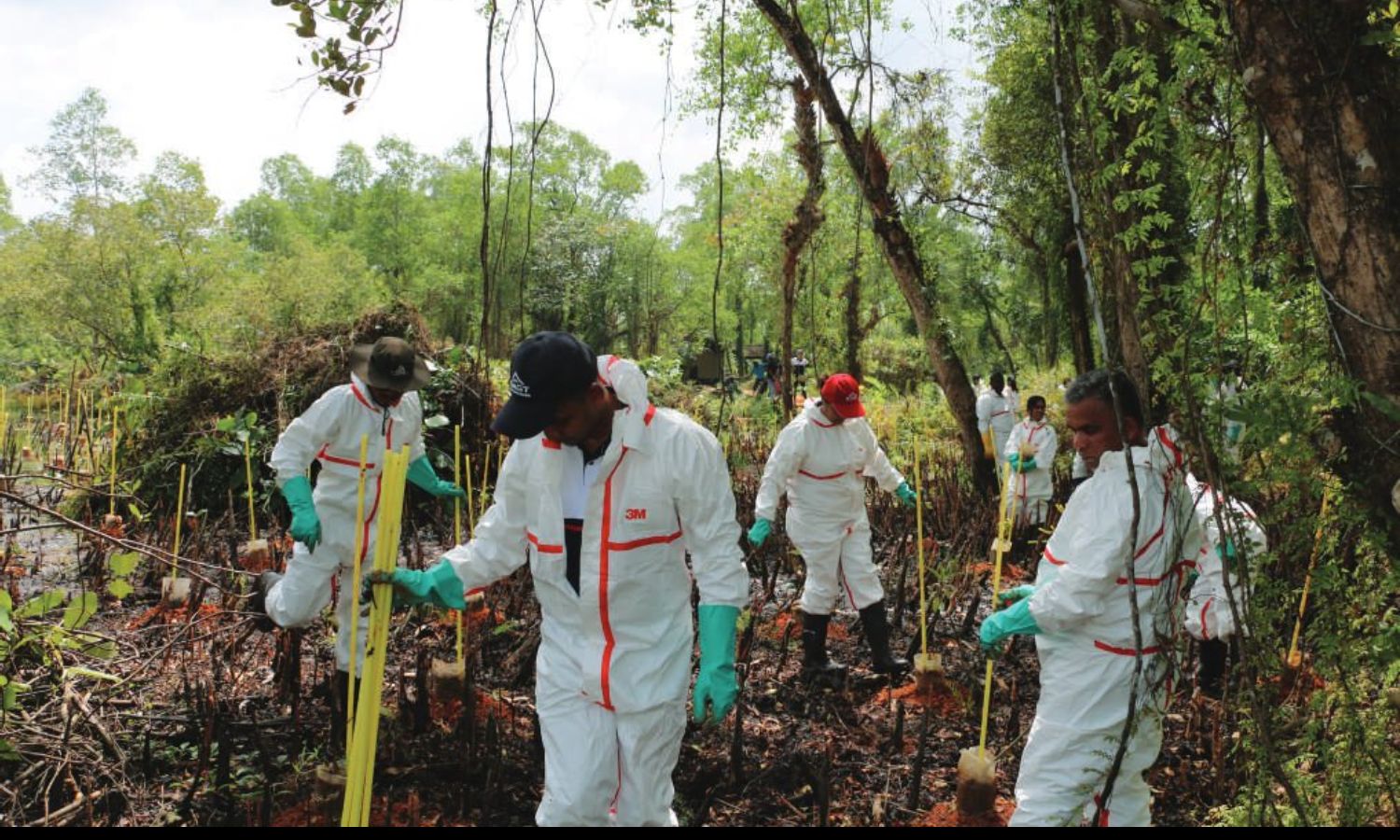
SAGT employees volunteering at the Ittapana mangrove project.
Nevertheless, it is important to
acknowledge that certain core terminal
operations, which include RTGs, prime
movers and inter-terminal transfer
(ITT) trucks, remain dependent on
diesel fuel. As such, fuel price volatility
continues to represent a material
operating cost consideration. However,
as our sustainability initiatives progress
through hybridisation, electrification,
route optimisation, and reduced idle
time, the relative impact of fuel price
increases on our overall cost base is
expected to diminish. This transition
strengthens SAGT’s long-term cost
resilience while supporting our
decarbonisation objectives.
During the year, SAGT commissioned
its 460 kW rooftop solar system.
During the FY 2025/26, SAGT’s roof
top solar system generated
391,585 kWh, which amounts to 5%
of the total electricity usage. We are
actively assessing opportunities to
extend solar installations to gatehouse
rooftops, to establish renewable
energy-powered “green gates” within
the Port of Colombo.
In parallel to this, SAGT also continues
investing in electric and energyefficient equipment to decarbonize
operations. As an initial step, two
electric forklifts and an electric
inspection vehicle for the Health,
Safety and Environment team. These
initiatives reduce emissions, lower
operating costs and contribute
to quieter and safer working
environments. Looking ahead, SAGT
plans to electrify 30 trucks from
its fleet of Prime Movers, which
will contribute further towards our
decarbonisation journey.
Water stewardship also remained
a priority during the year. Through
systematic identification and repair
of underground leaks and sustained
awareness campaigns, SAGT achieved
a 16% reduction in water withdrawal.
Looking ahead, the planned installation
of an Effluent Treatment Plant, subject
to site approvals, will most likely
enable the reuse of treated wastewater
for selected operations, potentially
offsetting approximately up to 50% of
current daily water usage and further
strengthening water resilience.
Beyond the terminal boundary, SAGT
continues to invest in ecosystem
restoration as part of its broader
climate strategy. Our long-standing
partnership with the Centre for
Sustainability of the University of
Sri Jayewardenepura progressed
further during the year through
advancement of the Benthara River
Mangrove restoration project at
Ittapana. These projects contribute to carbon sequestration, biodiversity
enhancement and sustainable
livelihoods for surrounding
communities all whilst reinforcing
environmental awareness among
our employees through volunteering
opportunities.
PEOPLE, SAFETY, AND SOCIAL
RESPONSIBILITY
Our people are central to SAGT’s
success and sustainability. The terminal
operating environment is inherently
high-risk, and ensuring the safety,
health and well-being of employees,
contractors and visitors remain
embedded in our core values.
During the reporting period, SAGT
continued to strengthen its safety
culture through training, systems
and the application of Digital Safety
Management System that consolidates
permits, incident reporting and
inspections which was implemented
in FY 2024/2025. A mandatory safety
refresher training was carried out
for all employees and contractors,
complemented by specialised training
for emergency response teams and
employees working in high-risk roles.
Lean level 01 training session
Beyond safety, we continued to
invest in human capital development
amid accelerating digitisation and
automation. During the financial year,
SAGT continued training programmes
across technical, leadership and safety
disciplines. Compared to 2024/25,
the 20% reduction in training hours in
2025/26 was due to a shift to needsbased training for skills upgrade and
knowledge onboarding. Nevertheless,
employee upskilling, training and
development remained a key priority
for SAGT in 2025/26.
During the year, SAGT continued the
adoption of organisation-wide LEAN
management principles under the
guidance of the APM Terminals Global
LEAN Academy. LEAN level 1 training
was conducted for all employees
with the intention of continuing the
LEAN level 2 program for selected
employees in the coming year. These
initiatives empower employees to
identify inefficiencies, drive process
improvements and contribute to
continuous operational excellence.
Advancing diversity and inclusion
remains a cornerstone of our social
agenda. The global port industry
has long been male-dominated,
with shift-based operational roles
rarely accessible to women due to
regulatory and cultural norms. Having
secured approval in September
2024 to employ women in selected
operational shift-based roles, SAGT has
since onboarded 13 women into shift
positions, pioneering a more inclusive
workforce model in Sri Lanka's port
sector and lifting our overall female
representation to 6.84% as of FY
2025/26.
GOVERNANCE AND ETHICAL
LEADERSHIP
Strong governance underpins SAGT’s
operations and sustainability journey.
The Company operates under a
robust governance framework aligned
with global best practices, with a
fully non-executive Board providing
strategic oversight. Policies such as
the Code of Conduct, Supplier Code
of Conduct, Whistleblowing Policy and
policies addressing harassment and
discrimination guide ethical behaviour
across the organisation and its value
chain.
LOOKING AHEAD
Looking to the future, we remain
optimistic about the long-term
prospects of SAGT and the Port of
Colombo. Capacity expansion at
the Port, sustained trade growth in
South Asia and continued investment
in technology, decarbonisation and
people, position us well to navigate
uncertainty and capture emerging
opportunities.
Consistent with global port industry
trends, digitalisation and automation
stayed at the core of SAGT’s
operational strategy during the
reporting period. Steady progress
was made on gate and quayside
automation infrastructure, supported
by the rollout of Optical Character
Recognition (OCR) technology. OCR
will enable fully automated gate
operations and partially automated
quayside processes by accurately
capturing container numbers, damage
status, and vehicle information,
reducing manual intervention,
enhancing data accuracy, and
improving safety.
SAGT has also advanced its Vehicle
Booking System (VBS) for trucks,
which assigns time slots and quotas
to spread gate transactions evenly
throughout the day. Supported by
a dedicated mobile app for drivers,
the system is expected to reduce
congestion, improve truck turnaround
times, minimize empty trips, and
enhance overall gate efficiency across
the port ecosystem. Addition to that,
four new STS cranes that will have
remote operation capability will be
implemented by the end of 2027.
ACKNOWLEDGEMENTS
I extend my sincere appreciation to
our customers for their continued
confidence, to our employees and
contractor partners for their dedication
and professionalism, to the Board of
Directors and Senior Management
Team for their guidance, to trade
unions for their responsible partnership
and to our suppliers, regulators and
community partners for their steadfast
support.
As a vital component of Sri Lanka’s
trade and logistics infrastructure, SAGT
will continue to lead with responsibility,
resilience and purpose, creating
sustainable value for our stakeholders
today while safeguarding the future for
generations to come.

Steen Knudsen
Chief Executive Officer