MANAGEMENT APPROACH
As a leading container terminal in
the Port of Colombo and a critical
node in global and regional trade
connectivity, South Asia Gateway
Terminals (SAGT) recognises
that responsible environmental
stewardship is fundamental to
sustaining long-term business
resilience, operational efficiency
and stakeholder trust. Terminal
operations rely on energy
intensive equipment, extensive
logistics movements, as well
as supporting infrastructure
that can create environmental
impacts through greenhouse gas
emissions, resource consumption,
waste generation and water
use. Accordingly, SAGT remains
committed to managing these
impacts responsibly while
advancing sustainable growth and
maintaining world-class service
standards.
Environmental stewardship at SAGT
is embedded within the Company’s
broader sustainability framework
and integrated into day-to-day
operational decision-making. The
Company continues to adopt a
proactive approach that seeks not only
to minimise adverse environmental
impacts, but also to identify
opportunities for innovation, efficiency
gains and long-term value creation.
This includes improving energy
productivity, modernising equipment
fleets, reducing dependence on
fossil fuels, strengthening waste
management systems, enhancing
responsible water use and supporting
ecosystem conservation initiatives
aligned with the Company’s
operational footprint.
Global warming continues to be
a global threat with increasing
anthropogenic emissions. 2025 has
been recorded as one of the three
warmest years on record.
The maritime and logistics sector
plays a vital role in enabling
international commerce, yet it is
also a significant contributor to
global greenhouse gas emissions.
The maritime industry is estimated
to account for approximately 3% of
global anthropogenic greenhouse gas
emissions (GHG), amounting to over 1
billion tons of CO2 annually. Container
terminals form an essential link
between sea and land transport and
therefore have a critical role to play
in supporting the decarbonisation of
trade logistics. SAGT continues to lead
by example at the Port of Colombo
through targeted investments in
cleaner technology, data-driven
performance management and
practical emission reduction initiatives.
During FY 2025/26, the Company
remained focused on staying the
course of its environmental transition
journey while continuing to pursue
measurable improvements across
identified material topics.
The Company’s material environmental
impact topics identified through its
internal materiality assessment and
addressed within its Sustainability
Management Framework are as
follows:

Materials Usage
GRI 301-1

Energy Consumption
GRI 302-1, 302-3, 302-4

Water Consumption & Effluent Discharge
GRI 303-1, 303-2, 303-3, 303-4, 303-5

Carbon Emissions
GRI 305-1, 305-2, 305-3, 305-4, 305-5, 305-6

Supplier Environmental Assessment
GRI 308-1

Waste Generation
GRI 306-1, 306-2, 306-3, 306-4, 306-5
As mentioned in the Sustainability
Integration section, robust data
systems are central to effective
environmental stewardship. SAGT
continuously monitors the above
material topics through the SPA
software tool covering aspects such as
resource consumption, environmental
compliance and emissions. These are
monitored through a combination of
digital systems, equipment records,
meter readings and operational data
capture processes. This enables the
Company to assess performance
trends, benchmark operational
efficiency, and also identify
opportunities for optimisation of such
resources.
Monthly monitoring of fuel
consumption, electricity use, water
withdrawal, waste generation and
emissions indicators provides
management with timely visibility
over environmental performance.
Variances are reviewed to determine
root causes such as operational
volume changes, equipment utilisation
patterns, maintenance cycles or even
process inefficiencies. Where required,
corrective measures are implemented
through engineering interventions,
behavioural awareness initiatives or
revised operating practices.
This disciplined performance
management approach also supports
transparent sustainability reporting
and enables SAGT to measure
progress over time. Historical trend
analysis continues to inform long
term planning, particularly in areas
such as emissions intensity reduction,
equipment modernisation and
renewable energy deployment.
ENVIRONMENTAL COMPLIANCE
AND RESPONSIBLE OPERATIONS
SAGT remains committed to
maintaining compliance with all
applicable environmental laws,
regulations, licences and permit
conditions. Environmental controls are
embedded into routine operations,
supported by monitoring, inspections,
preventive maintenance and third
party testing where required.
The Company’s Environmental
Protection Licence requirements
include ongoing monitoring of
relevant emissions and environmental
parameters. Internal teams work
closely with qualified external
specialists to ensure that testing,
reporting and remediation actions are
conducted to appropriate standards.
Beyond legal compliance, SAGT aims
to uphold responsible operating
practices that reflect stakeholder
expectations and the Company’s
values. No environmental grievances
of fines were recorded during
the reporting period, reflecting
the continued effectiveness
of management systems and
engagement channels.
Materials Usage (GRI 301-1)
Efficient use of materials remain a central pillar of SAGT’s environmental
stewardship strategy. As a high-performance container terminal operating
within a dynamic logistics environment, the Company relies on specialised
heavy equipment, mobile fleets, quay cranes, engineering assets and supporting
infrastructure, as well as other non-renewable consumables such as lubricants,
tyres, ropes and other consumables. Managing these resources efficiently is
therefore essential not only from an environmental standpoint, but also for
operational continuity, cost discipline and long-term competitiveness.
Non-renewable materials used by weight or volume
| Non-renewable materials used
by weight or volume
|
Consumption in
2025/26 |
Consumption in
2024/25 |
%
Difference |
| RTG Tyres in kg |
21,240 |
24,180 |
-12% |
| PM Tyres in kg |
58,880 |
46,320 |
27% |
| Lubricants in Litres |
62,877 |
66,439 |
-5% |
| Rope in kg |
71,448 |
111,003 |
-36% |
| Paper in kg |
2,498 |
2,405 |
4% |
During the reporting period, SAGT
continued to strengthen its resource
productivity agenda through
disciplined maintenance practices,
operational optimisation, targeted
technology investments and ongoing
monitoring. While cargo volumes
experienced a reduction during the
year, the Company remained focused
on ensuring that lower activity levels
translated into measurable efficiency
gains rather than simply reduced
consumption. This approach enabled
SAGT to record improvements across
several key non-renewable materials.
SAGT is committed to reducing the
use of non-recyclable materials across
its operations and systematically
applying the 3Rs principles - Reduce,
Reuse, Recycle - wherever practical
and feasible. The Company continues
to manage material usage carefully
by aligning consumption with actual
operating requirements, preventive
maintenance schedules and equipment
condition monitoring. Digital workflows
also contribute towards reductions in
paper use.
All maintenance materials are utilised
in accordance with original equipment
manufacturer (OEM) recommendations
and established engineering standards.
This disciplined approach ensures
reliability and safety while avoiding
premature replacement or unnecessary
material waste. Tyres, ropes and
lubricants are replaced based on wear
indicators, operating hours, tread
depth, move counts and inspection
outcomes rather than arbitrary time
based cycles.
During the reporting period, RTG tyre
consumption amounted to 21,240
kg from last year’s consumption of
24,180 kg, representing a 12% reduction
compared with the previous year. This
decline was primarily attributable
to lower replacement requirements
following tyre changes undertaken in
the prior period, as well as reduced
RTG utilisation associated with lower
cargo volumes. RTG tyres are not
ordinarily replaced annually unless
required by wear levels or damage.
The reduction, therefore, reflects
both prudent asset management and
reduced operational strain.
Prime Mover tyre usage totalled
58,880 kg from last year’s
consumption of 46,320 kg, an
increase of 27% year-on-year. The
increase was linked to scheduled
replacements based on tyre tread
depth and operating wear. Prime
Movers operate continuously across
the terminal environment and are
subject to demanding usage patterns.
To mitigate avoidable tyre damage,
SAGT continued to implement
housekeeping improvements and yard
sweeping activities, including the use
of magnetic sweepers to remove metal
debris that may cause punctures.
Employee awareness of careful driving
and safe yard practices also remained
an important preventative measure.
Lubricant consumption declined
from 66,439 litres to 62,877 litres,
a 5% reduction from the previous
year. Lubricants are consumed
primarily through planned servicing
and mechanical maintenance based
on machine operating hours. Lower
equipment utilisation during the
year reduced servicing frequency
requirements, thereby contributing to
lower lubricant use. This demonstrates
the linkage between productivity
planning, equipment deployment and
resource consumption.
Wire rope consumption reduced to
71,448 kg from 111,003 kg, reflecting
a 36% reduction year-on-year. Rope
replacement is linked to the number of
operational moves completed by Quay
Cranes and RTGs, in line with OEM
guidance and safety protocols. Lower
move counts during the year reduced
replacement requirements.
Administrative paper usage increased
to 2,498 kg from FY 2024/25
consumption of 2,405 kg, representing
a 4% increase over the previous year.
The Company continues to focus on
digitalisation and process automation
to reduce dependence on physical
documentation. Ongoing automation
of gate operations and progressive
digital workflows are expected to
support a longer-term downward trend
in paper consumption.
Overall, SAGT’s approach to materials
management reflects the principles
of operational necessity, lifecycle
optimisation and waste minimisation.
Energy Management and Operational
Efficiency (GRI 302-1, 302-3, GRI
302-4)
SAGT recognises that resource
efficiency is not achieved through
energy efficient equipment
replacement alone. Digitisation and
automation play an increasingly
important role in reducing energy
utilization by enabling smarter use of
existing assets and resources.
Advanced terminal operating systems,
routing optimisation tools and
planning technologies help minimise
unnecessary yard movements, which
also contribute to reducing waiting
times, improving equipment utilisation
and lowering fossil fuel and electricity
consumption.
As automation initiatives continue
to progress across gate and
quayside operations, the Company
expects further gains in productivity
and resource efficiency. These
improvements illustrate the strong
linkage between operational excellence
and resource efficiency.
SAGT’s operations require direct
energy in the form of diesel, petrol
and LPG, and indirect energy through
electricity purchased from the national
grid. The Company therefore places
strong emphasis on improving energy
efficiency, reducing dependence on
fossil fuels and integrating renewable
energy into its operations.
Total direct and indirect energy use continued to reflect disciplined
management
during the year
| Total Power Consumed in Giga Joules (GJ) |
GJ in 2025/26 |
GJ in 2024/25 |
% Difference |
| Diesel |
167,760 |
182,196 |
-8% |
| Petrol |
13 |
11 |
14% |
| LPG |
1,270 |
1,141 |
11% |
| Total Indirect Energy – from the National Grid |
34,027 |
37,299 |
-9% |
| Indirect Energy – National Grid (non‑renewable energy sources) |
18,664 |
24,990 |
-25% |
| Indirect Energy – National Grid (renewable energy sources) |
15,363 |
12,309 |
25% |
| Total Energy intensity per box move |
0.132 |
0.170 |
-23% |
Direct Energy Consumption
Diesel remains the largest single
energy source used by SAGT,
powering RTGs, Prime Movers,
Internal Terminal Transfer (ITT)
trucks, reach stackers, forklifts
and other heavy-duty equipment.
Total diesel energy consumption
amounted to 167,760 GJ from
last year’s consumption of
182,196 GJ, representing a 9%
reduction from the previous year.
This improvement was driven
by lower equipment operating
hours, reduced cargo volumes
and gains from hybrid equipment
deployment.
40%
consumed by Prime Movers
18%
consumed by the ITT fleet
Balance consumed by
other machinery and support vehicles
Petrol consumption increased to 13 GJ from 11 GJ, a 14% rise over FY 2024/25.
LPG consumption increased to 1,270 GJ from 1,141 GJ, a 11%
rise over the
previous year. This was mainly attributable to revised food preparation
methods in the kitchen and a temporary outage affecting certain electric
cooking equipment. While non-core to terminal operations, SAGT continues to
monitor LPG usage and seeks efficient energy alternatives where practical.
In volumetric terms, diesel consumption totalled 4,644,529 litres, a
decrease
of approximately 7.9% from the previous
year. Diesel usage composition shows the scale of operational dependence across major equipment categories:
Electricity Consumption
Electricity is critical to crane operations, workshops, lighting systems, office buildings and staff
facilities.
Total purchased electricity consumption amounted to 9,452,077 kWh in 2025/26 in comparison to
10,360,817 kWh in
2024/25, representing a 9% reduction. Of this total electricity consumption, 66% was consumed by the
Company’s ten
Quay Cranes, with the balance used across workshops, offices, yard lighting and administration areas.
Breakdown of electricity use
| Category |
Consumption in 2025/26 |
Consumption in 2024/25 |
% Difference |
| Quay Cranes |
6,234,830 |
6,982,830 |
-11% |
| Engineering Workshops, Main Office Building, Yard Lighting, Staff and Administration Areas
|
3,217,247 |
3,377,987 |
-5% |
| Total |
9,452,077 |
10,360,817 |
-9% |
The 9% reduction in the
consumption of electricity of the
Quay Cranes corresponded with
the 11% reduction in QC moves
during the year, indicating stable
operational efficiency despite
lower throughput.
RENEWABLE ENERGY TRANSITION
A major milestone during the reporting
period was the commissioning of SAGT’s
460 kWh rooftop solar system, which
became operational during the year. The
installation generated 391,585 kWh of
electricity during the reporting period,
equivalent to approximately 12.2% of
electricity requirements excluding Quay
Crane consumption. This investment
represents a practical step toward
reducing grid dependency, lowering
Scope 2 emissions and enhancing long
term energy resilience.
ENERGY INTENSITY
SAGT tracks energy intensity per box
move as a key indicator of operational
efficiency. During the year, total energy
intensity stood at 0.175 GJ per box
move, compared with 0.170 GJ in the
previous year. This 3% increase in energy
intensity reflects the Company’s ability
to maintain efficiency despite changing
operational volumes and activity
patterns.
Fleet Efficiency and Equipment
Optimisation
RTG Hybridisation Project
One of SAGT’s most impactful energy
efficiency and decarbonisation initiatives
has been the hybridisation of its RTG
fleet. During the year:
- 28 of 31 RTGs were hybrid units
- Hybrid RTG moves increased by 9%
- Non-hybrid RTG moves decreased by 64%
RTG diesel consumption reduced by
15% year-on-year. More importantly,
diesel efficiency per move improved
substantially.
- Hybrid RTG diesel efficiency: 0.73 litre
per move
- Non-hybrid RTG diesel efficiency: 1.77
litres per move
This equates to a 43.5% reduction in
diesel consumption per move for hybrid
units. Based on recorded efficiencies, the
RTG hybridisation project has generated
an estimated 2 million litres of fuel
savings, equivalent to a 53% reduction
versus conventional operations.
This initiative demonstrates
how technology upgrades can
simultaneously reduce emissions, fuel
costs and operating risk.
Prime Movers
Prime Movers consumed 1,857,044 litres
of diesel, a 8.5% reduction compared
with the previous year. This was mainly
due to a 7% reduction in operating hours
arising from lower terminal volumes.
In addition, diesel consumption per
running hour improved by 1.3%,
suggesting gains from smarter routing,
reduced congestion and improved yard
planning through digital tools such as
Navis and Prime Route.
Inter Terminal Transfer (ITT) Trucks
Diesel consumption by the ITT fleet
increased by 10%, corresponding with a
19% increase in trips performed during
the reporting period. This reflected the
use of SAGT’s internal fleet to provide
faster and more reliable customer
connections. While absolute fuel use
rose, the increase supported service
quality and supply chain responsiveness.
Greenhouse Gas Emissions (GRI 305-1,
305-2, 305-3, 305-4, 305-5, 305-6)
The Company’s pathway toward
lower-carbon operations is centred on
a practical combination of technology
upgrades, operational efficiency and
progressive electrification. During
the year, SAGT continued to advance
investments in green and energy
efficient technologies, recognising that decarbonisation must be pursued in
ways that also preserve productivity,
reliability and customer responsiveness.
During the reporting period, SAGT
purchased two electric forklifts and one
electric yard cab for its Health, Safety
and Environment functions, expanding
the operational presence of electric
mobility within the terminal. In addition,
the Company’s 460 kWh rooftop solar
installation became operational during
the year, generating an average of
44,000 kWh per month and supplying
approximately 5% of the terminal’s
electricity requirements, excluding
quay crane consumption, contributing
to renewable electricity generation to
support internal consumption.
Looking ahead, the Company plans to
electrify 30 Prime Mover trucks used
in terminal operations, a significant
initiative expected to further reduce
diesel dependency over time towards
enhanced decarbonisation. SAGT also
continues to evaluate the acquisition of
four new Ship-to-Shore cranes under a
green financing framework by the end
of 2027, demonstrating the alignment
of future capital expenditure with
sustainability objectives. This initiative
will boost efficiency, enabling further
improvement in Scope 2 emission
intensity.
SAGT monitors and reports greenhouse
gas emissions in line with recognised
methodologies. The Company follows
the Greenhouse Gas Protocol developed
by the World Resources Institute (WRI)
and the World Business Council for
Sustainable Development (WBCSD),
while applying IPCC AR6 -aligned
emission factors and relevant Sri Lankan
grid emission factors. Emissions from
CO2
, CH2
and N2
O are considered in
calculations.
Carbon Footprint by Energy Type
Total Scope 1 and Scope 2 emissions during the reporting period amounted to 16,636 MTCO2eq, representing an 10%
reduction from 18,469 MTCO2
eq in the previous year.
| Carbon Footprint by Energy Type |
2025/26 (MTCO₂eq) |
2024/25 (MTCO₂eq) |
% Difference |
% Composition 2025/26 |
| Diesel |
12,474 |
13,547 |
-8% |
75% |
| Petrol |
0.9 |
0.8 |
14% |
0.005% |
| LPG |
80 |
72 |
11% |
0.5% |
| Emissions from refrigerant and fire extinguishers |
323 |
641 |
-50% |
2% |
| Electricity |
3,839 |
4,209 |
-9% |
23% |
| Total |
16,717 |
18,469 |
-9% |
100% |
| CO2 |
16,352 |
17,782 |
-8.04% |
97.81% |
| CH4 |
15 |
16 |
-8.52% |
0.09% |
| N2O |
28 |
30 |
-6.18% |
0.17% |
The reduction in emissions was primarily driven by lower diesel use and lower electricity
consumption,
supported by
operational efficiencies and renewable energy generation.
Scope 1 Emissions (Direct)
Scope 1 emissions arise mainly from combustion of diesel, petrol and LPG, as well
as fugitive emissions from refrigerants and fire suppression systems. During the
year Scope 1 emissions declined to 12,879 MTCO2eq.
Diesel remains the dominant contributor to Scope 1 emissions, reflecting the
nature of terminal equipment fleets. Continued electrification and hybridisation,
therefore, remain key long-term levers for decarbonisation.
| Carbon Footprint |
2025/26
(MTCO₂eq) |
2024/25
(MTCO₂eq) |
% Difference |
| Scope 1 emissions |
12,879 |
14,261 |
-10% |
| CO₂ |
12,512 |
13,573 |
-8% |
| CH₄ |
15 |
16 |
-9% |
| N₂O |
28 |
30 |
-9% |
SAGT utilises refrigerant gases in the Company’s air conditioning units. In
the 2025/26, SAGT’s refrigerant gas usage resulted in total emissions of 323
MTCO2eq, based on the global warming potential (GWP) of each refrigerant type.
This is a 50% reduction in comparison to the previous year. During the reporting
period, SAGT utilised 54 kg of R-22 refrigerant which recorded 3kg of Ozone
Depleting Substances in R11 equivalent, arising from the use of R22 refrigerant
gas in air-conditioning.
|
Carbon Footprint of Refrigerant Refilled (by gases)
|
2025/26
(MTCO₂eq) |
2024/25
(MTCO₂eq) |
% Difference |
| R22 |
106.6 |
106.6 |
0% |
| R32 |
87.1 |
130.7 |
-33% |
| R407C |
- |
55.1 |
-100% |
| R410A |
129.3 |
347.9 |
-63% |
| Total |
323 |
640 |
-50% |
Scope 2 Emissions
(Indirect Electricity)
Scope 2 emissions arise from
purchased electricity from the national
grid. During the year, these emissions
declined to 3,839 MTC02eq, in line
with lower electricity consumption
corresponded with the reduced crane
moves and the contribution of onsite
solar generation.
Scope 3 Emissions
SAGT does not yet track all categories
of Scope 3 emissions, but plans are
in place to commence broader Scope
3 data collection from FY 2026/27.
During the year Scope 3 emissions
declined to 3,007 MTCO2eq.
The Company currently monitors
electricity consumed by refrigerated
containers (reefers), which is treated
as pass-through electricity paid for
by shipping lines and excluded from
Scope 2 totals. During the year, reefer
related emissions reduced by 13% to
3,007 MTCO2eq, mainly due to lower
volumes handled.
Emissions Intensity and Decarbonisation Progress
SAGT calculates GHG emission intensity per QC move as a key performance
metric.
| Carbon Footprint |
2025/26 (MTCO2eq) |
2024/25 (MTCO2eq) |
YOY % Difference |
| Scope 1 GHG emission intensity (kgCO2eq/ Box Move) |
11.14 |
11.01 |
1.2% |
| Scope 2 GHG emission intensity (kgCO2eq/ Box Move) |
3.32 |
3.25 |
2.3% |
| Total GHG emission intensity (kgCO2eq/ Box Move) |
14.47 |
14.26 |
1.5% |
Using 2019/20 as the base year, total
emissions intensity has reduced by
21%, reflecting sustained progress
over multiple years through cleaner
equipment, efficiency gains and energy
optimisation.
This long-term downward trajectory
demonstrates that SAGT’s
decarbonisation strategy is delivering
measurable outcomes even amid
fluctuating trade volumes and
operational complexity.
The hybridisation of Rubber Tyred
Gantry (RTG) cranes has continued
to deliver meaningful fuel efficiency
benefits while supporting lower
emissions intensity and operating
costs. These hybrid RTGs deliver
approximately 54% fuel savings per
move compared to conventional units.
Similarly, the deployment of two
electric forklifts: one with a 3-ton
capacity and another with a 5-ton
capacity and an electric inspection
vehicle in selected functions reflects
the Company’s intention to gradually
reduce dependence on conventional
fossil fuel-powered assets. Compared
to diesel-powered forklifts, each
electric forklift achieves an 77%
reduction in carbon footprint annually,
making a meaningful contribution
to emissions reduction. Similarly, the
electric double cab purchased for
the purpose of conducting safety
inspections is expected to deliver an
approximate 91% annual reduction in
carbon footprint in comparison to a
diesel powered vehicle.
The Company’s Environmental
Protection Licence (EPL), issued by
the Central Environmental Authority
of Sri Lanka, requires annual
monitoring of specific emissions
arising from operational equipment
such as Rubber Tyred Gantry cranes
and diesel generators. In line with
these obligations, SAGT engages
independent third parties to conduct
the required testing and verification
exercises.
As at 31 March 2026, all monitored
NOx and SOx emissions remained well
within stipulated quality thresholds,
and no violations of regulatory
emission limits were recorded during
the reporting period. This outcome
reflects the effectiveness of equipment
maintenance standards, fuel
management practices and emissions
control oversight.
SAGT recognises that energy transition
in container terminal operations
is a multi-year journey requiring
technology investment, disciplined
execution and collaboration across
stakeholders. The Company’s next
phase includes planned electrification
of 30 Prime Movers, acquisition of
four new energy-efficient Ship-to
Shore cranes under green financing
mechanisms by the end of 2027,
and further automation alongside
continued expansion of renewable
energy opportunities.
By integrating resource efficiency
with operational excellence, SAGT
continues to strengthen its position
as a responsible terminal operator
contributing to lower-carbon trade
logistics in Sri Lanka and the wider
region.
Water and Effluent Management
(GRI 303-1, 303-2, 303-3, 303-4 and
303-5)
Water is a shared and increasingly
valuable resource. SAGT understands
that climate variability, urbanisation
and competing demand can place
pressure on national water systems,
making efficient water use an
important business and societal
priority
Responsible management of water
resources and waste streams remains
an important component of SAGT’s
environmental stewardship agenda. As
a major container terminal operating
within the Port of Colombo, the
Company recognises that efficient
use of water resources are essential
to minimising environmental impacts,
maintaining regulatory compliance
and supporting resilient operations.
Although terminal activities are not
water-intensive in the same way as
certain manufacturing sectors, water
is still a critical operational resource
used across staff welfare facilities,
kitchens, sanitation systems, cleaning
processes, workshops and general site
maintenance.
SAGT’s approach to water is
therefore grounded in reduction,
efficiency, compliance and continuous
improvement. The Company continues
to monitor consumption trends,
identify opportunities for reduction.
During the reporting period, these
efforts contributed to measurable
improvements in water conservation,
while maintaining strong oversight
over effluent management practices.
Water management is integrated
into facilities maintenance and
environmental oversight processes,
with engineering teams responsible
for system upkeep, leak detection and
infrastructure reliability.
Effluent was discharged into the
municipal council drainage system
in the Port of Colombo, following
verification that the discharge met
the tolerance limits specified under
the Environmental Protection License
(EPL).
Water Withdrawal
The Company’s water stewardship
strategy focuses on prudent
withdrawal from approved municipal
sources, reduction of avoidable losses,
efficient internal use, monitoring of
effluent quality and fostering employee
awareness on conservation practices.
During the reporting period, total
water withdrawal amounted to 44,207
m3, representing a 16% reduction
compared with 52,488 m3 in the
previous year. On an operational
efficiency basis, this equated to a 7%
reduction in water withdrawal per box
move. All water withdrawals are fresh
water from water non-stressed areas,
as SAGT operates in Colombo which is
not considered a water stressed area.
The reduction was primarily
attributable to targeted leak
identification and repair initiatives
undertaken by the engineering
department. Proactive maintenance
of pipelines, fittings and distribution
systems helped eliminate avoidable
losses and improve overall water-use
efficiency across the terminal.
In addition, the Company continued
to conduct awareness programs
encouraging employees to conserve
water in washrooms, kitchens and
welfare facilities. Behavioural measures
such as promptly reporting leaks,
avoiding unnecessary running water,
and the mindful use of common
facilities complement engineering
interventions and help sustain long
term reductions.
SAGT does not extract water from
groundwater aquifers, seawater
sources or surface water bodies, and
does not currently engage in rainwater
harvesting. While municipal supply
remains sufficient for present needs,
the Company continues to assess
opportunities for future resilience
measures that may support sustainable
water sourcing over time.
Effluent Discharge
Effluent generated from sanitation
systems, kitchens and related facilities
is managed through established
infrastructure and monitored
processes. The Company takes care
to ensure that wastewater handling
does not create an adverse impact on
the surrounding port environment or
coastal ecosystem.
During the reporting period, total
effluent discharge amounted to an
estimated 27,962 m3, to water non
stressed areas (more than 1000TDS).
No violations were reported.
Effluent volumes are monitored daily,
while testing is conducted quarterly
by an independent third party. This
external verification helps ensure
that discharged water remains within
required quality parameters and that
any issues are identified early.
The operation of an oil-water separator
ensures that water discharge from
terminal activities meets stringent
environmental standards by effectively
removing oils and greases. The
planned installation of an Effluent
Treatment Plant, subject to site
approvals, will most likely enable
the reuse of treated wastewater
for selected operations, potentially
offsetting approximately up to 50% of
current daily water usage and further
strengthening water resilience.
Routine oversight of drainage systems,
treatment interfaces and wastewater
flows also supports operational
reliability and environmental
protection. Through these measures,
SAGT seeks to maintain high standards
of hygiene, compliance and responsible
environmental performance.
Water Consumption
Water consumed within the terminal is
largely linked to domestic and support
uses rather than embedded within
products or irreversible industrial
processes. This creates opportunities
for conservation through operational
discipline, infrastructure upkeep and
user behaviour. During the reporting
52 South Asia Gateway Terminals (Pvt) Ltd
period, the water consumption
amounted to 16,245 m3. There were
no changes in the capacity of water
storage tanks during the year.
The reduction in withdrawal during
the year indicates that SAGT’s current
management controls are delivering
positive outcomes. The Company
remains committed to maintaining
momentum by:
- Continuing periodic leak detection
and preventive maintenance
- Promoting responsible employee
water-use behaviour
- Reviewing the efficiency of fixtures
and plumbing systems
- Monitoring monthly trends for
abnormal spikes in usage
- Evaluating future conservation
technologies where practical
As climate resilience becomes
increasingly important, prudent water
stewardship will remain an ongoing
focus area.
Waste Management and Circularity
(GRI 306-1, 306-2, 306-3, 306-4,
306-5)
Waste management is another material
area for SAGT, given the engineering
intensive nature of terminal
operations. Maintenance activities,
packaging materials, food services
and infrastructure upkeep generate
a diverse range of waste streams
including oils, batteries, tyres, metals,
wire rope, paper, cardboard, plastics
and food waste.
The Company’s waste strategy
prioritises:
-
Reduction at source
- Segregation by waste category
- Reuse and recovery wherever
feasible
- Safe disposal of residual materials
- Engagement of licensed recyclers
and handlers
- Employee awareness and
accountability
This hierarchy supports both
environmental outcomes and
responsible resource use.
Waste Management Approach (GRI
306-1 and 306-2)
SAGT continues to manage waste in
line with regulatory requirements and
internal environmental controls. Waste
is segregated at source into hazardous
and non-hazardous categories,
with further separation based on
recyclability, recovery potential and
safe disposal method.
Engineering and maintenance waste
streams are closely monitored,
given their scale and environmental
sensitivity. Hazardous waste includes e-waste, used oil, contaminated
cotton waste, batteries and chemical
containers are stored, transported and
processed through authorised service
providers. Non-hazardous materials
includes metals, tyres, cardboard and
plastics are channelled for recovery
and recycling wherever possible.
Internal awareness programmes
continue to encourage proper
segregation, housekeeping discipline
and responsible disposal practices
across departments.
| Waste Generated |
UOM |
2025/26 |
2024/25 |
YOY % Difference |
| Hazardous Waste |
|
|
|
|
| Waste Oil |
kg |
39,132 |
43,659 |
-10% |
| Contaminated Cotton Waste |
kg |
24,596 |
25,400 |
-3% |
| Batteries |
kg |
5,259 |
4,862 |
8% |
| Biomedical waste |
kg |
5 |
3 |
67% |
| Empty chemical containers |
kg |
5,141 |
8,030 |
-36% |
| E-waste |
kg |
8,024 |
- |
- |
| Total Hazardous Waste |
kg |
82,157 |
81,954 |
0.25% |
| Non-Hazardous Waste |
|
|
|
|
| Food Waste |
kg |
70,000 |
64,924 |
8% |
| Tyres |
kg |
104,500 |
44,510 |
135% |
| Iron, Tin, Copper and Wire rope |
kg |
654,992 |
353,198 |
85% |
| Engineering Waste (Including paper, cardboard and plastic) |
kg |
768,000 |
835,200 |
-8% |
| Total Non-Hazardous Waste |
kg |
1,597,493 |
1,297,832 |
23% |
| Total Waste Generated |
|
1,679,649 |
1,379,786 |
21.7% |
During the reporting period, SAGT
generated a total of 1,679,649 kg of
waste, representing a 21.7% increase
compared with the previous year. The
increase was largely attributable to
higher volumes of waste tyres and
metal-related waste, including iron, tin,
copper and wire rope and electronic
waste.
Of total waste generated:
- 95% was non-hazardous waste
- 5% was hazardous waste
Hazardous Waste
Total hazardous waste generated
during the year amounted to 82,157 kg,
a marginal 0.25% increase from
81,954 kg in the previous year.
The reductions in waste oil and
contaminated cotton waste can be
linked to lower machine maintenance
activity, as servicing intervals are based
on running hours. Lower equipment
utilisation during the year, therefore,
translated into lower maintenance
waste generation.
The increase in batteries reflected
scheduled replacements and lifecycle
renewals of electrical components and
backup systems.
SAGT continues to ensure that
hazardous waste is handled only
through competent and licensed third
parties in accordance with applicable
regulations.
Non-Hazardous Waste
Total non-hazardous waste generated
amounted to 1,597,492 kg, an 23%
increase from 1,297,832 kg the previous
year.
Tyre Waste
The sharp increase in tyre waste
was linked to higher Prime Mover
tyre replacements during the year. In
response, the Company continued
measures to reduce punctures and
premature damage through:
- Improved housekeeping in
operational yards
- Periodic magnetic sweeping to
remove sharp metal objects
- Employee awareness of careful
vehicle movement and reporting
hazards
These preventative actions aim
to extend tyre life and reduce
replacement frequency over time.
Metal and Rope Waste
Higher volumes of iron, copper, tin
and rope waste reflected replacement
cycles of engineering materials and
operational components. These
materials generally carry high recovery
potential and are channelled through
authorised recyclers, supporting
circularity objectives.
Engineering Waste
The reduction in engineering
waste, including paper, cardboard
and plastics, suggests progress in
consumption control and practices in
handling material.
Food Waste Management
Food waste represented approximately
4.15% of total waste generated during
the year. Total food waste amounted to
70,000 kg, an increase of around 8%
over the previous year.
The Company continues to conduct
awareness sessions for employees on
responsible food consumption and the
importance of avoiding unnecessary
waste. Food waste is managed
through third-party channels for reuse
as animal feed.
Waste Diverted from Disposal (GRI 306-4, 306-5)
SAGT continues to prioritise diversion of waste from landfill or unmanaged
disposal through reuse and recovery pathways.
| Hazardous Waste |
UOM |
2025/26 |
2024/25 |
YOY % Difference |
| Waste diverted from disposal |
|
|
|
|
| Recovery (batteries) |
kg |
13,283 |
4,862 |
173% |
| Waste directed to disposal |
|
|
|
|
| Incineration (contaminated cotton waste, biomedical waste, waste oil, empty chemical
containers)
|
kg |
68,874 |
77,092 |
-10.7% |
| Non-Hazardous Waste |
UOM |
2025/26 |
2024/25 |
YOY % Difference |
| Waste diverted from disposal |
|
|
|
|
| Reuse (Food Waste) |
kg |
70,000 |
64,924 |
8% |
| Recovery (engineering waste including paper, cardboard and plastic) |
kg |
1,422,992 |
1,188,398 |
20% |
| Waste directed to disposal |
|
|
|
|
| Incineration (Tyres) |
kg |
104,500 |
44,510 |
135% |
These figures demonstrate the
substantial proportion of SAGT’s
waste streams that continue to be
channelled into beneficial reuse or
material recovery pathways rather than
disposal.
Supplier Environmental Assessment
(GRI 308-1)
SAGT recognises that environmental
responsibility extends beyond its
terminal boundaries. Accordingly, the
Company continues to strengthen
environmental expectations across its
supply chain and engages suppliers
through self-declaration processes
covering environmental and social
compliance at onboarding stages.
Equipment suppliers, contractors,
maintenance vendors, logistics
partners and service providers all play
a role in influencing the Company’s
wider sustainability performance.
Accordingly, responsible engagement
in the supply chain continues to be
an important component of SAGT’s
environmental stewardship framework.
During the year, the Company
streamlined its pool of significant
suppliers based on the scope of
goods and services they provide
and initiated steps to strengthen
environmental screening through
supplier self-declaration mechanisms.
These declarations are intended to
confirm supplier awareness of and
commitment to relevant environmental
and social compliance expectations.
At the point of onboarding
or registration, new suppliers
and customers are required to
complete self-declarations covering
environmental and social responsibility
matters. This process helps embed
sustainability expectations early in
the commercial relationship and
encourages responsible conduct
across the value chain.
SUPPLIER SELECTION AND
ENVIRONMENTAL EXPECTATIONS
During the reporting period, no
new environmental criteria were
introduced in supplier selection,
with the Company continuing to
apply the established principles and
requirements used in prior years. These
criteria are designed to ensure that
suppliers meet appropriate standards
relating to quality, compliance, safety,
service capability and responsible
business conduct. 27 suppliers were
assessed through environmental
practice audits, even though no new
suppliers were audited.
While no new criteria were added,
SAGT continued to strengthen
implementation practices and supplier
engagement processes. SAGT
strengthened supplier engagement
and implementation practices by
54 South Asia Gateway Terminals (Pvt) Ltd
maintaining a rigorous purchasing
policy and a transparent supplier
screening process incorporating
sustainability criteria. All suppliers must
adhere to the SAGT Supplier Code of
Conduct.
FUTURE SUPPLY CHAIN
PRIORITIES
Whilst adhering to the growing
importance of Scope 3 impacts, ethical
sourcing and resilient procurement,
SAGT also intends to progressively
strengthen the oversight of supplier
sustainability in future years. Planned
areas of focus include:
- Periodic audits of significant
suppliers
- Stronger documentation of
environmental compliance status
- Improved waste and materials
traceability among service providers
- Engagement on low-carbon
products and services where feasible
- Greater alignment between
procurement decisions and
sustainability priorities
By progressively integrating
sustainability into supplier
management, SAGT can amplify
positive environmental outcomes
beyond its own operations.
BIODIVERSITY AND PARTNERING
FOR CONSERVATION
As a container terminal whose
operations depend fundamentally on
healthy oceans, functioning coastal
systems and resilient trade routes,
SAGT recognises that environmental
stewardship must include protection
of biodiversity and restoration of
ecosystems. Marine and coastal
environments face increasing threats
from pollution, habitat destruction,
climate change and unsustainable
resource use. These risks have direct
implications not only for ecological
well-being, but also for maritime
industries that rely on healthy seas and
shorelines.
SAGT therefore continues to support
practical conservation initiatives
through partnerships with scientific
institutions, government agencies and
employee volunteers. These programs
are designed to generate measurable
environmental value while also raising
awareness among employees and
communities.
Beach Clean-Up and Partnership with
MEPA
Ocean health is under growing
pressure from adverse human activity,
including plastic pollution, overfishing,
habitat destruction and climate
change. It is estimated that millions of
tonnes of plastic enter the oceans each
year, contributing to damage across
marine and coastal ecosystems. In Sri
Lanka, coastal pollution pressures have
increased alongside urbanisation and
industrial concentration in shoreline
areas.
As a company operating at the
interface of sea and land transport,
SAGT recognises that it has both a
responsibility and a vested interest in
protecting ocean health. Clean and
resilient marine environments are
integral to sustainable maritime trade.
To support this objective, SAGT
continued its partnership with the
Marine Environment Protection
Authority (MEPA) and conducted its
annual beach clean-up initiative in
2025.

SAGT Employees and Families in Action for
Coastal Conservation

SAGT Employees and Families in Action for
Coastal Conservation
Building Awareness Through
Participation
This year, the Company broadened
participation by encouraging the
families of employees to join the
clean-up effort. By involving spouses
and children, SAGT sought to extend
environmental awareness beyond
the workplace and help foster
values of responsible waste disposal
and resource stewardship within
households and future generations.
The initiative provided a practical
platform for employees and their
families to witness the scale of coastal
waste challenges first-hand while
contributing directly to cleaner public
spaces.
Broader Value of the Initiative
The beach clean-up program
generated benefits beyond litter
removal alone. These included:
- Reinforcing employee awareness on
marine pollution
- Building a culture of volunteerism
and environmental responsibility
- Strengthening stakeholder
collaboration with national
authorities
- Promoting family participation in
sustainability initiatives
- Demonstrating SAGT’s commitment
to coastal stewardship
By combining awareness, action and
partnership, the program reflects how
relatively simple interventions can
create meaningful environmental and
social value.
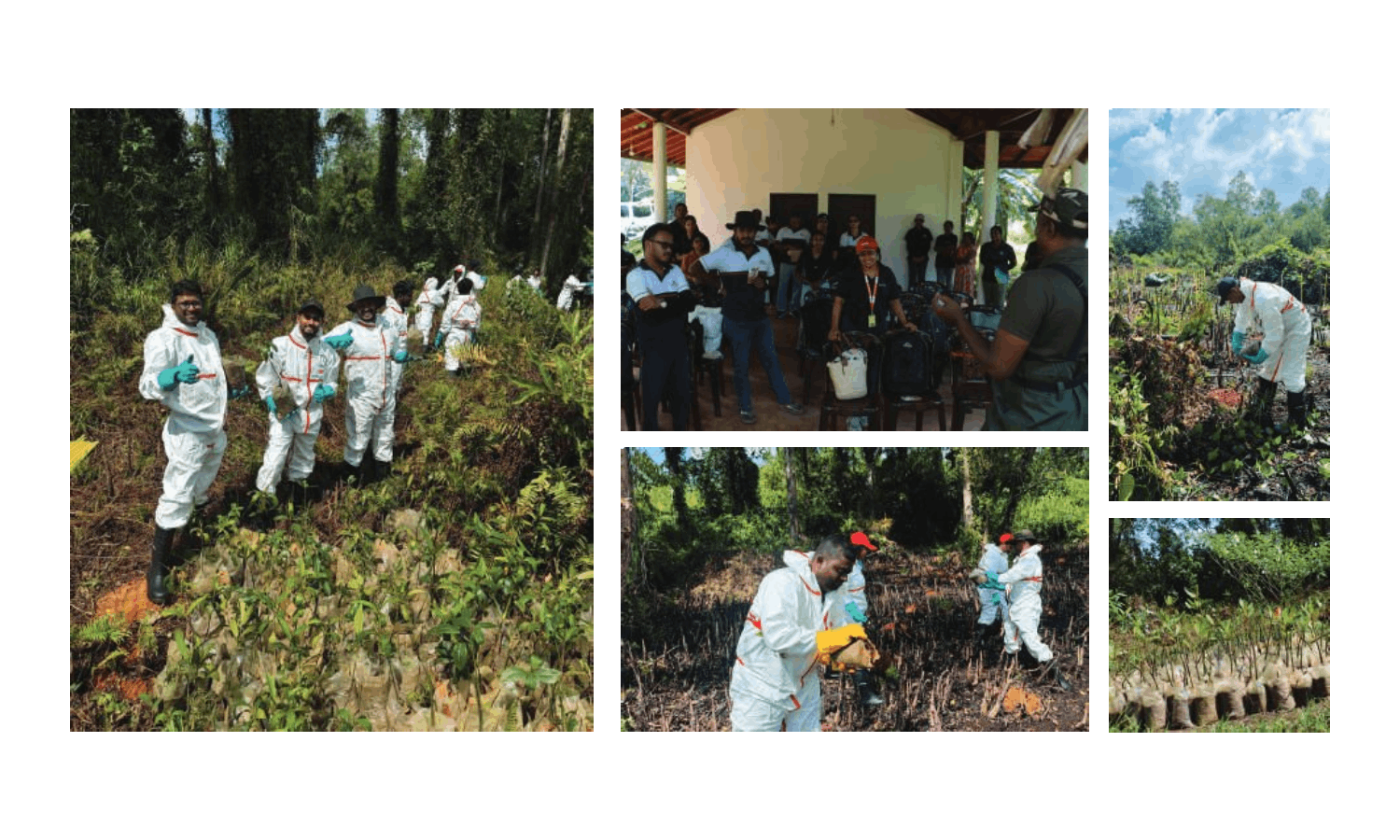
MANGROVE RESTORATION IN THE BENTOTA RIVER MANGROVE COMPLEX
One of SAGT’s most significant nature-based climate initiatives is its mangrove
restoration partnership with the University of Sri Jayewardenepura. Through
this collaboration, the Company is supporting the restoration of five acres of
mangroves within the Bentota River Mangrove Complex in southern Sri Lanka.
Execution of the project commenced in the fourth quarter of the 2024/25 and continued to
progress during the current year.
Why Mangroves Matter
Mangroves are among the world’s most
valuable coastal ecosystems. They:
- Act as natural carbon sinks by capturing and
storing carbon in root systems and soils
- Protect coastlines from erosion and storm
surges
- Support biodiversity, including fish nurseries
and bird habitats
- Improve water quality through sediment
capture
- Support livelihoods in surrounding
communities
Although smaller in area than inland forests,
coastal ecosystems can sequester carbon at
particularly high rates over long periods.
Environmental and Social
Benefits
The Bentota project
is expected to
contribute to ecosystem
restoration, reduce land
erosion and generate
sustainable livelihood
opportunities for local
communities. Based
on project estimates,
the restored area may
offset approximately
16% of SAGT’s current
annual carbon footprint,
demonstrating the
significant climate value of
blue-carbon ecosystems.
Progress During the Year
During the reporting period:
- Initial site clearance and
phased land preparation
progressed
- Approximately 1,500
plants were established
across 2 acres of the site
- Adaptive restoration
techniques were used to
address challenging mud
and waterlogged soil
conditions
- SAGT employees visited
the site and participated
in planting activities
The project utilised practical ecological methods to improve survival rates,
including raised planting zones and
stabilisation supports suited to local hydrological conditions.
By involving employees directly in planting visits, the initiative also helped
translate corporate climate
commitments into tangible action. Participation fostered a deeper understanding of biodiversity
restoration and
the relationship between ecosystem health and climate resilience.
Conservation Partnership: Yagirala
Forest Reserve
SAGT’s commitment to ecosystem
restoration predates the current
reporting cycle. In 2019, the
Company agreed with the Centre for
Sustainability of the University of Sri
Jayewardenepura to restore five acres
of the Yagirala Forest Reserve.
This earlier initiative reflected
the Company’s recognition that
reforestation and habitat restoration
can play an important complementary
role alongside direct emissions
reduction. The continued reference to
Yagirala within SAGT’s environmental
journey highlights a long-term
approach to conservation rather than
isolated one-off projects. Specifically,
reforesting five acres within the reserve
offsets roughly 9% of SAGT’s current
carbon footprint.
Environmental expectations facing
the maritime and logistics sector
will continue to intensify in the years
ahead. Customers increasingly seek
lower-carbon supply chain partners.
Regulators are tightening climate and
environmental standards. Investors
and lenders are paying closer attention
to sustainability performance.
Communities expect businesses
to contribute positively to the
environments in which they operate.
SAGT is well-positioned to respond
to these shifts through a practical,
data-driven and forward-looking
stewardship strategy.
KEY PRIORITIES FOR THE FUTURE
The Company’s likely environmental
priorities over the medium term
include:
- Further decarbonisation through the
electrification of operational fleets
- Acquisition of more efficient
equipment supported by green
financing
- Expansion of renewable energy
generation capacity
- Broader Scope 3 emissions data
collection and management
- Stronger supplier sustainability
engagement and audits
- Enhanced circularity in materials and
waste streams
- Ongoing biodiversity partnerships
and nature-based climate action
As one of the region’s leading
container terminals, SAGT has an
opportunity to demonstrate that
trade facilitation and environmental
responsibility can progress together.
Through disciplined operations,
targeted investment and meaningful
partnerships, the Company continues
to reduce its environmental footprint
while enabling efficient maritime
commerce through the Port of
Colombo.
Environmental stewardship is therefore
not a peripheral agenda for SAGT. It
is increasingly integral to resilience,
competitiveness and long-term value
creation. By staying the course on
decarbonisation, resource efficiency
and ecosystem protection, SAGT is
helping shape a more sustainable
future for Sri Lanka’s logistics sector
and the wider maritime economy.