Container terminals
continue to play a
pivotal role in enabling
global trade, economic
development and
supply chain resilience.
Sri Lanka’s strategic
positioning in the Indian
Ocean, which directly
spans the East–West
Main Sea Route (ESMR),
provides the country with
a distinct competitive
advantage as a regional
transshipment hub. This
geographic strength
allows vessels to access
South Asia, the Middle
East, and East Asia
with minimal deviation,
thereby reinforcing
the Port of Colombo’s
(PoC) long-standing
role in global maritime
connectivity.
During the calendar year 2025, the
Port of Colombo demonstrated strong
performance amidst a dynamic global
operating environment. The port
handled 8.3 million TEUs, the highest
volume in its history, representing 6.5%
year-on-year growth, with 84% of total
volume attributed to transshipment
cargo. This transshipment-heavy
profile continued to insulate the
port’s performance from residual
domestic economic challenges, placing
greater emphasis on global trade
flows, geopolitical developments, and
regional import-export dynamics.
The prolonged Red Sea crisis,
which began in 2023 and continued
throughout 2025, disrupted global
shipping routes, forcing vessels to
reroute via the Cape of Good Hope
and extending voyage times by up to
two weeks. While Colombo’s strategic
proximity to the East–West Main Sea
Route enabled the port to capture
diverted cargo flows, the geopolitical
landscape grew increasingly complex
during the reporting period. Notably,
the blockade of the Strait of Hormuz,
triggered by the outbreak of the
Iran–US conflict in February 2026,
introduced a new geopolitical tension
and economic instability disrupting
shipping services and cargo volumes
leading to vessel by-passes and
reduced throughput. Against this
backdrop, the port faced rising fuel
prices and increasing operating costs,
despite maintaining operational
continuity as an essential service.
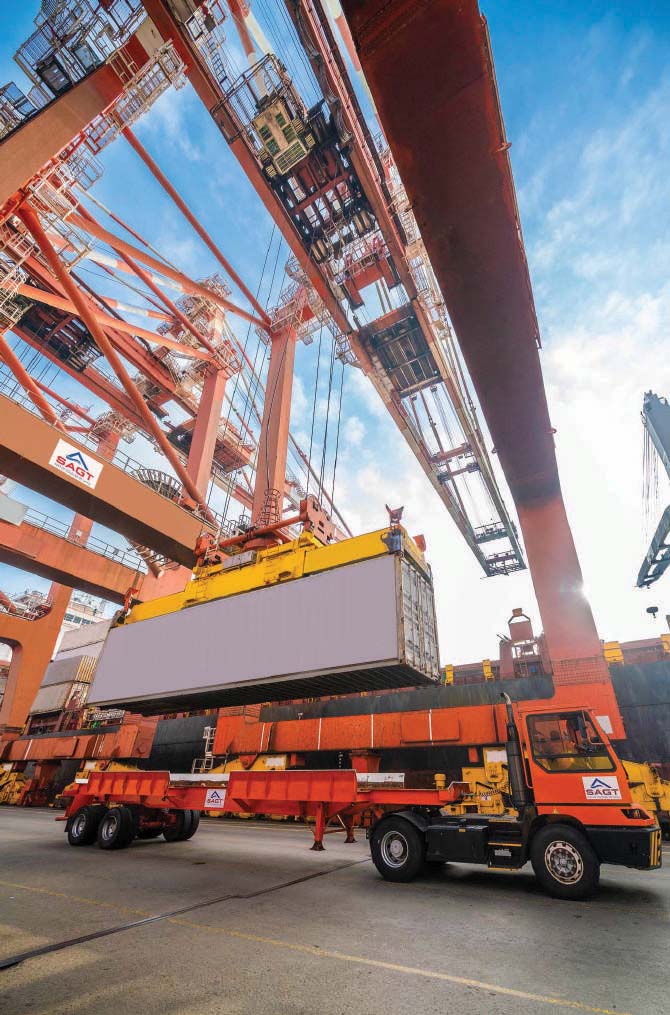
Enhancing trade connectivity while advancing sustainable port operations
The South Asian region, led by India,
remains a key driver of maritime trade
growth. India posted an economic
growth of approximately 7.4% in
FY2025/26, maintaining its position
as one of the fastest-growing major
economies. Significant investments
in port infrastructure, including
the commissioning of new deepdraft transshipment hubs such as
Vizhinjam, reflect India’s ambition
to expand its direct connectivity.
Importantly, regional trade growth
has proven complementary rather
than competitive to Colombo’s hub-and-spoke model, with Colombo
continuing to capture significant Indian
transshipment volumes.
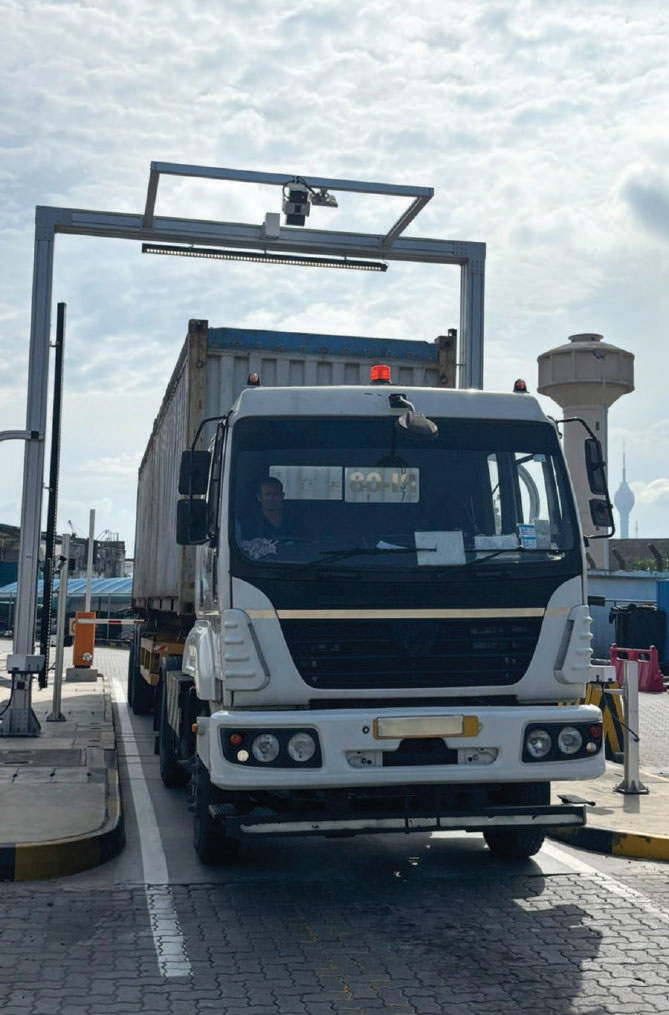
Steady progress in gate automation infrastructure, powered by Optical Character
Recognition (OCR) technology.
Capacity expansion at the Port of
Colombo saw significant progress
during the year with commencement
of operations at the Colombo West
International Terminal (CWIT). The
ongoing developments for the
completion of CWIT and the East
Container Terminal (ECT) will add
further capacity to PoC. Looking
ahead, plans are also underway
to rebuild the existing breakwater
for the development of West
Container Terminal 2 (WCT2). These
developments are expected to bring
the Port’s overall capacity to about
15 million TEU. Within this evolving
landscape, South Asia Gateway
Terminals (SAGT) remains strategically
positioned to support deep-draft
terminals as a feeding terminal and
reinforces Colombo’s role as a regional
transshipment hub.
Against this backdrop, SAGT handled
1.8 million TEUs in the financial year
2025/26, representing a 11% decrease
compared to the previous year. This
reduction can be attributed to the
onset of the Strait of Hormuz crisis in
the latter part of the year in review.
The crisis impacted throughput
influenced by the suspension of a
key Gulf centric service with related
shifting of volume flows within the PoC
terminals. Further, added capacity in
the Port aided the increase in overall
volumes and influenced a slight
redistribution of volumes among the
terminals through consequent service
upsizing. During the latter part of
the financial year, SAGT undertook
a comprehensive quay crane rail
replacement project, which required
operating on a reduced two-berth
configuration from October 2025 to
March 2026. While this constrained
berth availability in the short term, the
project significantly strengthens the
terminal’s infrastructure, enhancing
long-term reliability, safety and
container handling capability. Despite
these constraints, SAGT continued to
operate well above its original design
capacity of 1.1 million TEUs, underlining
the terminal’s operational efficiency,
planning discipline, and workforce
capability.
The Company’s ability to sustain
high throughput under constrained
conditions reflects the effectiveness
of its operational systems and its
continuous focus on optimisation.
In line with global port industry
trends, digitalisation and automation
remained central to SAGT’s operational
strategy during the reporting
period. Infrastructure development
for gate and quayside automation
progressed steadily, supported by the
implementation of Optical Character
Recognition (OCR) technology by
the second quarter of 2026. OCR will
enable fully automated gate operations
and partially automated quayside
processes by accurately capturing
container numbers, damage status,
vehicle information, reducing manual
intervention, enhancing data accuracy
and also improving safety.
SAGT has also advanced the
implementation of a Vehicle Booking
System (VBS) for trucks, which will
allow the terminal to spread gate
transactions evenly throughout the
day by assigning time slots. The
system, which is supported by a
dedicated mobile application for truck
drivers, is expected to significantly
reduce congestion, improve truck
turnaround times, empty trips and
enhance overall gate efficiency across
the port ecosystem. Addition to that,
four new STS cranes that will have
remote operation capability will be
commissioned by the end of 2027.
Operational excellence initiatives were
further strengthened through the
organisation-wide rollout of LEAN
management principles, supported by
structured training delivered under the
guidance of the APM Terminals LEAN
Academy. 32% of total employees
completed LEAN Level 01 training
during the year, establishing a shared
foundation in continuous improvement.
Numerous Kaizen initiatives and
“Just Do It” improvements were
implemented across functions, which
embeds a culture of problem-solving,
efficiency and safety at every level of
the organisation.
Decarbonisation remains a core
strategic priority for SAGT as the
maritime industry transitions towards
a lower-carbon future. During the
year, SAGT made tangible progress in
reducing its environmental footprint
through investment in cleaner
technologies, operational efficiency
and renewable energy.
In FY2024/25, 28 of SAGT’s 31
Rubber-Tyred Gantry (RTG) cranes
had been converted to hybrid
technology, achieving approximately
50% reductions in diesel consumption
per move compared to conventional
RTGs. This transition has resulted in
significant fuel savings and contributed
meaningfully to reductions in Scope 1
emissions.
SAGT’s 460 kW rooftop solar array
became fully operational during
the year, generating an average of
44,000 kWh per month and supplying
approximately 5% of the terminal’s
electricity requirements, excluding
quay crane consumption. Additional
renewable energy opportunities,
including solar installations on
gatehouse rooftops, are being
evaluated to further increase on-site
renewable generation.
During the year, the Company also
added electric equipment to its fleet,
purchasing two electric forklifts and
an electric inspection vehicle for its
HSE team. These initiatives, together
with improved energy management,
resulted in year-on-year reductions in
total energy consumption and an 10%
reduction in total carbon footprint
despite sustained high operational
intensity.
Looking ahead, SAGT is well
positioned to benefit from regional
trade growth, increased capacity
at the Port of Colombo, as well
as its own strategic investments
in infrastructure, technology,
sustainability and people. While
short-term volume fluctuations
are expected during periods of
industry and port-level capacity
realignment, SAGT’s long-term
fundamentals remain strong.
Through disciplined execution,
continuous improvement and a
clear commitment to sustainability
and operational excellence, SAGT
will continue to play a vital role in
supporting the Port of Colombo’s
evolution as a leading global
transshipment hub.